
How to Compare Kalshi and Polymarket Odds Live
Learn how to compare matching Kalshi and Polymarket odds in real time, verify settlement rules, track price gaps, and assess whether a difference is meaningful.
Kalshi and Polymarket often list markets about the same event, but the prices are not always identical.
A market may show one probability on Kalshi and a slightly different probability on Polymarket. Sometimes the difference reflects new information arriving at different speeds. Sometimes it comes from thin liquidity, different settlement rules, or markets that only appear to match.
Comparing the two prices is easy. Comparing the same market correctly is harder.
This guide explains how to compare Kalshi and Polymarket odds in real time, verify that the markets actually match, and determine whether a price difference is meaningful.
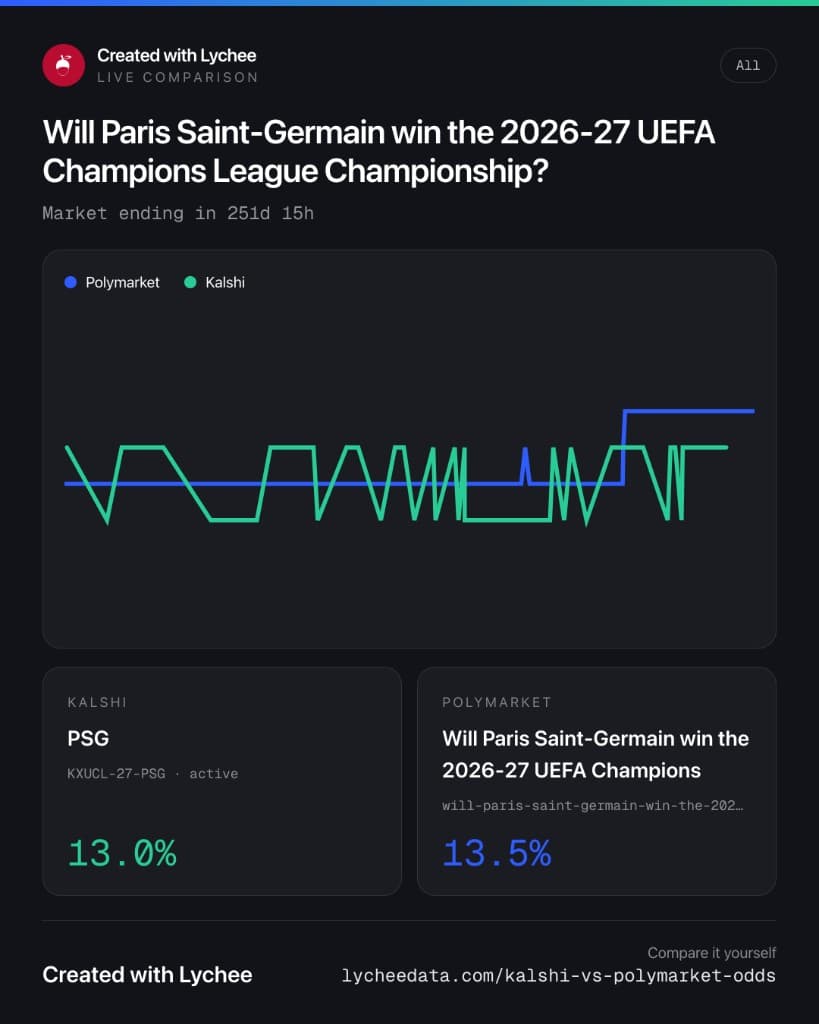
What does an odds comparison actually measure?
Prediction-market prices are commonly interpreted as implied probabilities.
For example, a YES contract trading at 62 cents is often read as approximately a 62% probability that the event will occur. That interpretation is useful, but it is only a starting point. Fees, bid-ask spreads, liquidity, market wording, and settlement rules can all affect the price you see.
A comparison should therefore answer four questions:
- Are both markets about exactly the same event?
- Are the YES and NO outcomes pointing in the same direction?
- Are both markets using comparable resolution rules?
- Are the prices being compared at the same point in time?
If any of these conditions fail, the apparent difference may not represent a genuine disagreement between the two platforms.
Why the same event can have different prices
A Kalshi market and a Polymarket market can refer to the same broad topic while still producing different prices.
The most common causes are:
- Different market wording
- Different event deadlines
- Different data sources
- Different settlement criteria
- Different treatment of ambiguous outcomes
- Different liquidity levels
- Different update speeds
- Different groups of traders
- Different bid-ask spreads
- Temporary stale prices
For example, two markets may both ask whether an interest-rate cut will happen, but one may resolve using an official central-bank announcement while the other uses a particular economic data source. The markets are related, but they are not interchangeable.
This is why matching the market question is only the first step.
Step 1: Find the same event on both platforms
Start with a specific event rather than comparing broad categories.
Good candidates include:
- A scheduled economic announcement
- An election outcome
- A sports result
- A weather measurement
- A policy decision
- A company or technology milestone
Search for the event on Kalshi and Polymarket using the main subject, date, and outcome.
For example, instead of searching only for “Fed,” include the relevant decision date and outcome:
- Federal Reserve rate decision March
- Fed cut 25 basis points
- Team championship winner 2026
- Candidate wins election
The goal is to locate the exact contract on each platform, not merely two markets that discuss the same general subject.
Step 2: Confirm that the markets actually match
Before comparing prices, read the resolution details on both markets.
Check the following:
The event definition
Does each market refer to the same event?
A market about whether a team wins a championship is different from a market about whether that team reaches the final. A market about a candidate winning a primary is different from one about winning the general election.
The deadline
Do both markets resolve at the same time?
A market asking whether something happens before the end of the month is different from one asking whether it happens before the end of the year.
The source of truth
What source determines the result?
One market may use an official government release. Another may use a public database, a sports league announcement, or a specific news source.
The exact threshold
Thresholds must match precisely.
“Will inflation be above 3%?” is different from “Will inflation be at least 3%?” The difference between “above,” “at least,” and “below” can materially change the outcome.
The outcome direction
Make sure YES means the same thing on both platforms.
Some comparisons accidentally place YES on one platform next to NO on the other. That can make a normal market look like a huge disagreement.
Step 3: Normalize YES and NO prices
Kalshi and Polymarket may display outcomes differently, so normalize the direction before calculating a gap.
If both markets represent the same YES outcome:
Price gap = Polymarket YES price − Kalshi YES price
If one platform is showing the opposite side:
Equivalent YES price = 1 − NO price
For example:
- Kalshi YES: 42¢
- Polymarket NO: 55¢
- Equivalent Polymarket YES: 45¢
The meaningful comparison is therefore 42¢ versus 45¢, a three-percentage-point difference.
Without this conversion, the comparison can be completely misleading.
Step 4: Compare prices at the same time
A price comparison is only useful when the timestamps are comparable.
Prediction-market prices can change quickly after:
- News releases
- Official announcements
- Sports injuries
- Polling updates
- Economic data
- Large trades
- Sudden changes in liquidity
If you check Kalshi first and Polymarket several minutes later, the difference may simply reflect market movement during that interval.
Record:
- The exact timestamp
- The price on Kalshi
- The price on Polymarket
- The last-trade time
- The current bid and ask, if available
A useful comparison might look like this:
At 14:32:10 UTC, the equivalent YES contract traded at 58¢ on Kalshi and 61¢ on Polymarket. The raw difference was three percentage points.
That statement is more useful than saying that one platform was “higher” without specifying when the observation occurred.
Step 5: Look at the price history
A single price snapshot does not tell you whether a gap is persistent.
Overlay the price history from both platforms and check:
- When the gap appeared
- Whether one platform moved first
- Whether the gap closed quickly
- Whether the gap widened after a major trade
- Whether both markets were inactive
- Whether one market repeatedly led the other
A gap that lasts for only a few seconds may be caused by update timing. A gap that persists for hours may deserve closer investigation, but it still does not prove that the markets are mispriced.
The time window also matters. Compare several intervals:
- 15 minutes for very recent movement
- 1 hour for short-term divergence
- 6 hours for intraday behavior
- 1 day for broader context
Step 6: Check trades, volume, and order-book depth
The displayed price is not always the price at which you can execute a meaningful position.
Before treating a gap as actionable, inspect:
- Recent trade prices
- Trade timestamps
- Trading volume
- Best bid
- Best ask
- Available size
- Spread between bid and ask
- Number of active orders
Suppose Kalshi displays a YES price of 40¢ and Polymarket displays 45¢. That five-cent difference may look attractive. But if the 40¢ price is only available for a few contracts, or the 45¢ price is the last trade from ten minutes ago, the apparent spread may not be usable.
This is the difference between a displayed price gap and an executable price gap.
An illustrative comparison
Consider a hypothetical event where both platforms appear to ask whether the same candidate wins an election.
At the same timestamp:
- Kalshi YES: 56¢
- Polymarket YES: 60¢
- Raw difference: 4 percentage points
Before interpreting the difference, verify:
- Both markets use the same election.
- Both markets resolve on the same date.
- Both use the same definition of victory.
- Both rely on comparable official results.
- The prices are current rather than stale last trades.
- Enough liquidity exists at both prices.
- The difference remains visible across more than one observation.
If the gap disappears within seconds, it may have been caused by timing or a temporary order-book imbalance. If it persists while both markets have active liquidity, it becomes a more interesting market-structure observation.
How to compare Kalshi and Polymarket odds in Lychee
Lychee lets you bring matching Kalshi and Polymarket markets into one workspace so you can inspect the prices together.
Open the Kalshi vs Polymarket odds comparison tool, then:
- Search for an event using natural language.
- Review the suggested Kalshi and Polymarket matches.
- Confirm the market wording and outcome direction.
- Compare the current YES and NO prices.
- Select a time window.
- Overlay the price histories or view them side by side.
- Inspect recent trades and volume.
- Review available bid and ask information.
- Move the selected markets into dashboard mode for a deeper comparison.
Dashboard mode is useful when you want to monitor several markets at once. You can place markets in separate tabs, add additional charts, compare price movement, and inspect market activity without repeatedly switching between platforms.
The comparison is most useful when it preserves the context around the price:
- The market question
- The platform
- The outcome
- The timestamp
- The price history
- Recent trades
- Liquidity information
Is a price difference automatically arbitrage?
No.
A difference between two displayed prices is not automatically a risk-free trading opportunity.
You still need to account for:
- Different settlement rules
- Fees
- Slippage
- Bid-ask spreads
- Position limits
- Available liquidity
- Transfer and funding delays
- Account restrictions
- The possibility that the markets are not truly equivalent
The two platforms may also resolve the same-looking event differently. If one market settles according to a specific official source and the other uses a different source, buying both sides does not eliminate resolution risk.
The correct first question is not “How large is the spread?”
It is:
“Do these two contracts represent the same claim, and can both sides actually be traded at the displayed prices?”
Why live comparison is more useful than a single snapshot
A static comparison tells you what the prices were at one moment.
A live comparison shows how the markets behave:
- Which platform moves first
- How quickly the other platform follows
- Whether the gap persists
- Whether volume increases during the divergence
- Whether the gap closes after a large trade
- Whether one venue consistently leads on a particular market type
This turns the comparison from a simple price check into a way to study market behavior.
You can use the same workflow for political markets, sports markets, economic events, weather markets, and other contracts that appear on both platforms.
Frequently asked questions
Are Kalshi and Polymarket odds usually the same?
They may be close when both platforms have active liquidity and participants are responding to the same information. They can still differ because of timing, liquidity, wording, fees, and settlement rules.
Why are Kalshi and Polymarket showing different odds?
The difference may come from a genuine change in market expectations, a temporary order-book imbalance, stale prices, different trader populations, or contracts that are not actually equivalent.
How do I compare Kalshi and Polymarket odds live?
Find the matching event on both platforms, verify the resolution rules, normalize YES and NO directions, compare prices at the same timestamp, and inspect the price history, trades, and available liquidity.
Is the displayed price the true probability?
It is commonly interpreted as an implied probability, but it is still a market price. Fees, spreads, liquidity, and contract rules affect how closely it represents a tradable probability.
Is every difference between Kalshi and Polymarket arbitrage?
No. A visible difference may disappear before execution or may reflect different settlement terms. You must verify the contracts and available liquidity before treating a spread as meaningful.
Can I compare sports and political markets?
Yes, provided that both contracts refer to the same event, outcome, deadline, and settlement definition.
Related reading
- Kalshi vs Polymarket: compare live odds
- How to Track Polymarket Odds Over Time
- Kalshi Live Data
- Polymarket Live Data
Conclusion
Comparing Kalshi and Polymarket odds is more than placing two numbers next to each other.
A useful comparison verifies that the markets match, converts the outcomes into the same direction, records the prices at the same time, and checks whether the difference persists after accounting for trades, spreads, liquidity, and settlement rules.
With Lychee, you can monitor matching markets in one view, compare their price histories, inspect market activity, and move the markets into a customizable dashboard for deeper analysis.
Go from raw markets to charts and dashboards in seconds—no code, no CSVs.
Free to explore here · Polymarket, Kalshi, Chainlink & more
More reading
Compare Kalshi and Polymarket Odds in Real Time
Find matching prediction markets across Kalshi and Polymarket, then compare their live YES/NO prices, charts, trading activity, volume, spreads and order books in one view. Search by event or ticker and see where the two markets agree—or disagree. Free to use with no signup required.
What Does Volume Mean on Kalshi? Trading Volume Explained
Learn what volume means on Kalshi, how trading volume works, why it matters, and how to analyze Kalshi market activity using historical volume charts.
When Do Prediction Markets Become Accurate? A Kalshi Political Market Lifecycle Analysis
Are prediction markets accurate? We analyzed 3,195 resolved Kalshi political prediction markets across 25,552 lifecycle snapshots to measure when market odds become reliable.
Are 90% Prediction Markets Reliable? A Kalshi Political Calibration Study
We analyzed resolved Kalshi political markets to test whether 90–100% prediction markets are overconfident. The data showed high-probability markets were reliable, while the middle probability range was sparse and noisy.
How to Build a Kalshi Weather Volatility Chart (Step-by-Step Guide)
Step-by-step guide to calculating and visualizing volatility in Kalshi weather markets using historical trade data and no-code analysis in Lychee.
How to Build a Probability Calibration Chart Using Kalshi Weather Markets (Accuracy Analysis Guide)
Step-by-step guide to building a probability calibration chart using Kalshi historical weather market data and bucketed prediction analysis in Lychee.